Tempered Glass
Jenny Lee

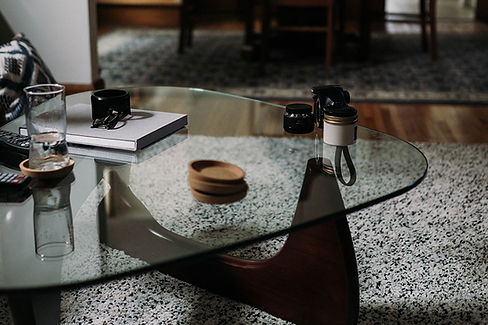
General Information
Tempered glass is preferred in applications where strength, safety, and thermal resistance are required. Its mechanical strength is 4-5x higher than annealed glass. It also has higher thermal strength and can withstand high-temperature changes. Tempered glass shatters completely into small and somewhat harmless pieces when under higher levels of impact energy. The main ingredient of glass is sand (silica) which is an inorganic material that is combined with flux (sodium carbonate or soda) and lime to reduce the melting point and prevent water solubility. Tempered glass is heated at 600+ degrees celsius which then receives high-pressure blasts of cold air for 3-10 seconds. The outer surface cools quickly and contracts, constraining the hot inner core as it continues to cool.
For installation, it is important to specify glass with pre-made holes or else drilling will cause it to shatter. Tempered glass can be cleaned with mild soap and lukewarm water. Use a clean, soft cloth applying light pressure to avoid making scratches.
Environmental Impact
Tempered glass production uses a lot of energy for high temperatures. The combustion of natural gas/fuel oil and the decomposition of the raw material during melting leads to carbon dioxide emissions. Tempered glass is also not biodegradable, however, is fully recyclable.
Tempered glass has no effect on indoor air quality.


Use in Interior Setting
1. Eilat Dar installed this tempered glass wall that separates the kitchen and bathroom for a sense of privacy.
2. Future Simple Studio designed this family apartment featuring wood and glass structures made of tempered glass.
3. "The Invisible House" covered a building entirely in mirrored, tempered glass to reflect the surrounding landscape.
4. Lualdi created these glass sliding doors made of tempered glass to represent traditional Japanese interiors.
5. Max Voytenko's tables feature wavy steel rods topped with a sheet of tempered glass.

Shower Door
For a shower door made of tempered glass, it is first important to decide which type of door you will choose. There are sliding, fixed, swing, framed, and frameless shower doors. This is dependent. on the size of the space and the needs/wants of the user. Though not required, it is highly recommended to apply a protective coating to prevent hard water build-up and soap scum. Tempered glass is available in many styles to make it easier to distinguish and to avoid walking into the clear glass. Acid-etched has a frosted look, tinted has a subtle color, and patterned has a texture.
Testing Organizations:
Contract Laboratory - https://www.contractlaboratory.com/directory/laboratories/by-industry.cfm?Tempered-Glass-Testing-Laboratories&i=687
Intertek - https://www.intertek.com/building/glass-glazing/
Safety Glazing Certification Council - https://www.sgcc.org/
Relevant standards through ASTM:
ASTM C1048 - 18: Standard Specification for Heat-Strengthened and Fully Tempered Flat Glass
ASTM E1300: Practice for Determining Load Resistance of Glass in Buildings
ASTM C1279 - Test Method for Non-Destructive Photoelastic Measurement of Edge and Surface Stresses in Annealed, Heat-Strengthened, and Fully Tempered Flat Glass

Sources
1. Knowles, E. & Miller, K. (2014) "A Comprehensive Guide for Selecting Interior Finishes."
2. http://www.glass-academy.com/tempered-glass-2/#:~:text=Characteristics%20of%20Tempered%20glass%3A,considered%20as%20a%20safety%20glass.3. https://www.onedayglass.com/how-is-tempered-glass-made/
4. https://www.ioflive.com/resources/IOF_Care_Maintenance_2016.pdf
5. https://uphomely.com/tempered-glass-environmentally-friendly
6. https://www.diynetwork.com/how-to/rooms-and-spaces/doors-and-windows/how-to-install-a-new-window
7. https://www.astm.org/DATABASE.CART/HISTORICAL/C1048-12.htm
8. https://www.glassgenius.com/blog/things-to-know-before-choosing-glass-shower-door-for-bathroom/#Different-Types-of-Shower-Doors
9. https://abcglassandmirror.com/what-kind-of-glass-are-shower-doors-made-of/